
7 Situations Where a Screened Cable Is the Better Choice
Published date: August 19, 2026
AI Summary
Screened cable is often the better choice when sensitive signals or data cables are exposed to electromagnetic interference from motors, drives, switching equipment or nearby power circuits.
Screening can help protect signal integrity, but the cable must still be correctly specified, routed, terminated and suited to its operating environment.
Key Takeaways
- Screened cable is most useful where electromagnetic interference is a genuine risk. Motors, drives, switching equipment and power cables are common sources of electrical noise.
- Sensitive signals require greater protection from interference. Analogue sensors, instrumentation and communication circuits can be affected by relatively small amounts of induced noise.
- Screening should complement good cable routing. Separating sensitive signal cables from power circuits remains important even when screened cable is used.
- The screen is only one part of the cable specification. Conductor size, voltage rating, mechanical duty and environmental conditions must still suit the application.
- Manufacturer requirements should take priority. If equipment documentation specifies a particular screened cable or termination method, follow that specification rather than substituting a generic alternative.
What Makes a Cable Need Screening?
Not every electrical installation needs screened cable.
Screening becomes more relevant when unwanted electromagnetic energy could interfere with the signal travelling through a cable. Common sources include motors, variable frequency drives, transformers, power conductors, relays and switching equipment.
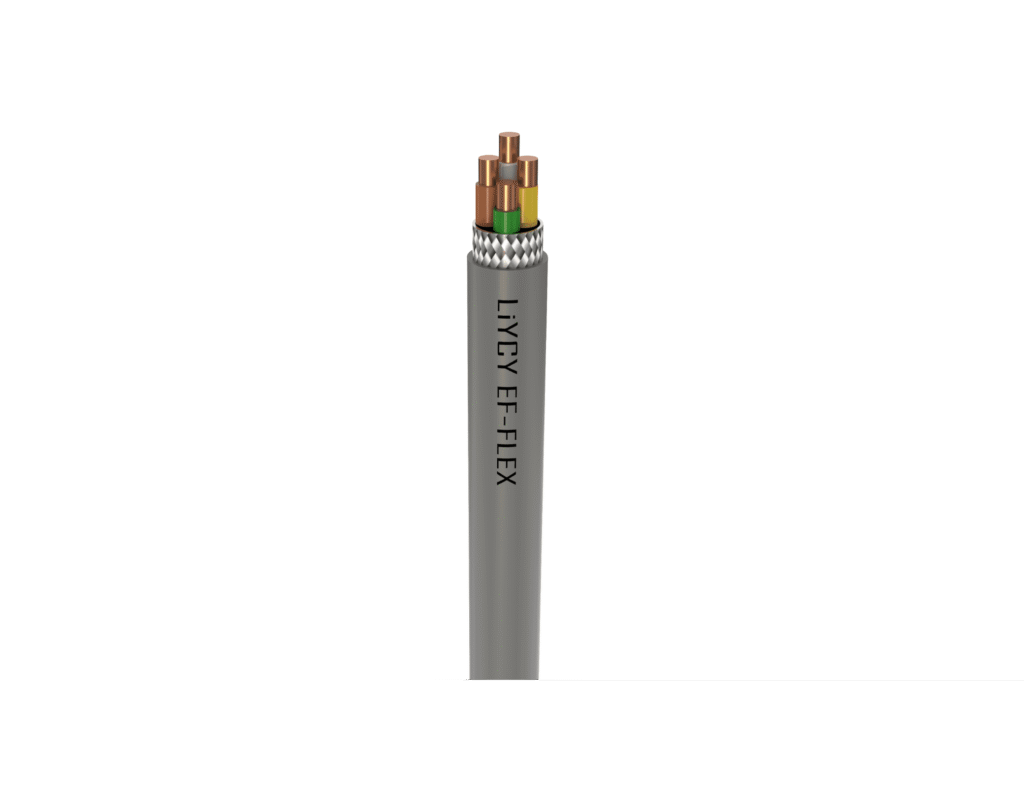
A screened cable incorporates a conductive layer around its conductors to help reduce this interference.
Knowing when to use screened cable therefore comes down to three practical questions:
- How sensitive is the signal?
- How much electrical noise surrounds the cable?
- How important is reliable signal or data transmission?
Where the signal is sensitive and the electromagnetic environment is demanding, screening becomes considerably more valuable.
1. Signal Cables Run Close to Motors or Variable Frequency Drives
Motors and variable frequency drives are common sources of electromagnetic noise in industrial installations.
The risk becomes more significant when sensitive control or signal cables:
- Run parallel to motor cables
- Share cable trays
- Enter the same control cabinet
- Pass close to drives or transformers
- Cannot maintain adequate separation from power wiring
In these circumstances, screened cable can provide additional protection against interference.
However, screening should not compensate for poor routing. Signal and power cables should still be separated where practical, particularly over long parallel runs.
The stronger approach is to combine appropriate cable separation with suitable screening.
2. You Are Carrying Low-Level Analogue or Sensor Signals
Low-level analogue signals can be particularly susceptible to electrical noise because the useful signal itself may be relatively small.
Typical applications include:
- Temperature sensors
- Pressure transmitters
- Flow sensors
- Load cells
- Encoder feedback
- Analogue measurement circuits
Even a relatively small induced voltage can distort a reading or cause it to fluctuate.
For example, a sensor may be operating correctly while the signal arriving at the controller becomes unstable because of nearby electrical interference.
Where measurement accuracy and signal stability are important, screened cable can help reduce the influence of surrounding electrical equipment.
3. Cables Are Installed in Industrial Automation Systems
Industrial automation equipment often combines sensitive control circuits with numerous potential interference sources.
A typical machine may contain:
- PLCs
- Motors
- Servo drives
- Relays
- Contactors
- Solenoids
- Switching power supplies
- Sensors
These devices may be installed within the same cabinet or machine structure.
A signal cable that performs reliably during bench testing may therefore behave differently once installed alongside operating drives and switching equipment.
For this reason, screened cable is often considered for sensitive control and instrumentation circuits within automated machinery, particularly where maintaining physical separation from noise sources is difficult.
4. Reliable Industrial Data Communication Is Critical
Industrial communication systems rely on maintaining consistent signal quality.
Electromagnetic interference does not always cause a complete communication failure. Instead, it may produce:
- Communication errors
- Lost or corrupted data
- Retransmissions
- Intermittent connections
- Sporadic equipment faults
These symptoms can be difficult to diagnose because they may only occur while nearby machinery is operating.
Industrial protocols may also specify particular cable constructions because characteristics such as impedance, pair arrangement and screening affect transmission performance.
In these cases, it is not enough to choose any screened cable. The cable must meet the requirements of the communication system itself.
5. Signal and Power Cables Must Share Congested Routes
Ideally, sensitive signal cabling should be routed away from high-current power conductors and other major interference sources.
In practice, space can be limited by:
- Existing cable trays
- Compact machinery
- Restricted conduits
- Control cabinet layouts
- Retrofit constraints
Signal and power cables may therefore need to run close together for part of their route.
Where adequate separation cannot be achieved, screened cable can provide additional protection against electromagnetic coupling.
This is particularly relevant where long parallel runs are unavoidable.
Even then, screening should complement good installation practice rather than replace it.
6. You Are Working in an Electrically Noisy Industrial Environment
Some industrial environments contain multiple interference sources operating simultaneously.
Examples include:
- Manufacturing plants
- Process automation facilities
- Production lines
- Machine-building environments
- Large control systems
- Facilities containing numerous motors and drives
In these settings, electromagnetic interference may come from several systems rather than one identifiable source.
Screened cable can therefore be useful where reliable signal transmission is critical.
However, the cable must still suit its mechanical duty. A screened cable intended for fixed installation, for instance, should not be selected for continuous movement unless its construction is designed for that purpose.
7. The Equipment Manufacturer or Project Specification Requires Screening
In some applications, the decision has already been established by the equipment or project specification.
Documentation may specify:
- Cable construction
- Screen type
- Characteristic impedance
- Conductor size
- Maximum cable length
- Connector type
- Screen termination
- Earthing or bonding requirements
Where these instructions are provided, they should guide cable selection.
It is also important not to substitute a generic screened cable simply because the specification includes the word “screened”.
Two screened cables can have very different electrical and mechanical characteristics. The complete specification must therefore be matched, not just the presence of a screen.
When Screened Cable May Not Be Necessary
Screened cable is not automatically the better choice for every circuit.
An unscreened cable may be suitable where:
- Electromagnetic interference levels are low
- The signal is not particularly sensitive
- Power and signal wiring can be adequately separated
- The cable is well separated from interference sources and operates in a low-noise environment
- The equipment manufacturer does not require screening
- The existing installation operates reliably without it
Adding screening where it provides no practical benefit can increase cable diameter, cost and installation complexity.
The technically better cable is therefore the cable suited to the application, not simply the one with the most construction layers.
Which Type of Screening Should You Choose?
Once screening is necessary, the screen construction also needs to suit the application.
| Screen Type | General Characteristic | Often Considered For |
| Foil screen | High coverage with relatively slim construction | Signal, instrumentation and data applications |
| Braided screen | Mechanically robust and flexible | Industrial control and flexible applications |
| Foil and braid | Combines broad coverage with additional robustness | More demanding interference environments |
The most appropriate construction depends on the interference frequency, installation conditions, movement and required flexibility.
Screen selection should therefore form part of the complete cable specification.
Quick Checklist for When to Use Screened Cable
| Question | Screening Becomes More Relevant When… |
| Is the signal sensitive? | Small amounts of interference could affect readings or communication |
| Are motors or drives nearby? | Strong electrical noise sources are present |
| Can cables be separated? | Signal and power cables must run close together |
| Is data reliability critical? | Communication faults could affect equipment operation |
| Is the environment electrically noisy? | Multiple switching devices operate nearby |
| Does the manufacturer specify screening? | Screening forms part of the equipment requirements |
If several of these conditions apply, screened cable warrants serious consideration.
Choosing the Right Screened Cable
Deciding when to use screened cable starts with understanding both the signal and the electrical environment around it.
Screening becomes particularly valuable where sensitive analogue signals, industrial communications or control wiring operate close to motors, drives, switching equipment and power cables.
For installations where electromagnetic interference is a concern, explore Eco-Flex’s range of screened cables or speak with the team about the electrical, mechanical and environmental requirements of your application.
Correct cable selection at the specification stage can help maintain signal integrity and ensure the screen performs as intended. If you need guidance on selecting a suitable cable, you can also contact Eco-Flex to discuss your application requirements.
Frequently Asked Questions
When should screened cable be used?
Screened cable should be considered when sensitive control, signal or communication circuits are exposed to electromagnetic interference from motors, drives, switching equipment or nearby power cables.
Is screened cable always better than unscreened cable?
No. Screened cable is most valuable where interference is a genuine concern. In low-noise environments with good cable separation, an unscreened cable may be entirely suitable.
Does screened cable eliminate electromagnetic interference completely?
No. Screening helps reduce interference, but effective EMC performance also depends on cable routing, screen termination, earthing, bonding and the overall installation design.
Should screened cable be used near variable frequency drives?
It is often advisable to use screened cable for sensitive signal and control circuits located near variable frequency drives because these can generate significant electrical noise. The exact cable and termination method should follow the equipment manufacturer’s requirements.
What type of cable screen is best for industrial applications?
There is no single best option. Foil, braid and combined foil-and-braid screens each suit different interference frequencies, flexibility requirements and installation conditions, so the screen should be selected as part of the complete cable specification.