
Can You Replace an Unscreened Cable with a Screened Cable? What to Consider First
Published Date: August 19, 2026
AI Summary
Replacing an unscreened cable with a screened cable is possible in many applications, but it should not be treated as a simple like-for-like upgrade.
The replacement cable must still meet the required conductor size, voltage, signal, mechanical, and environmental specifications. At the same time, the screen must be terminated and earthed correctly in accordance with the equipment and installation requirements.
Replacing an unscreened cable with a screened cable can help where electromagnetic interference affects control, signal or communication circuits. However, it is not always a direct swap.
The replacement must still meet the circuit’s electrical, mechanical and environmental requirements, while the screen must be correctly terminated and integrated with the earthing and bonding arrangement.
When comparing a screened cable vs an unscreened cable, remember that screening is only one part of the specification. Matching core count or conductor size alone does not make two cables equivalent.
What Changes When You Move from an Unscreened to a Screened Cable?
An unscreened cable consists primarily of insulated conductors surrounded by an outer sheath. It does not include a conductive screening layer specifically designed to control electromagnetic interference.
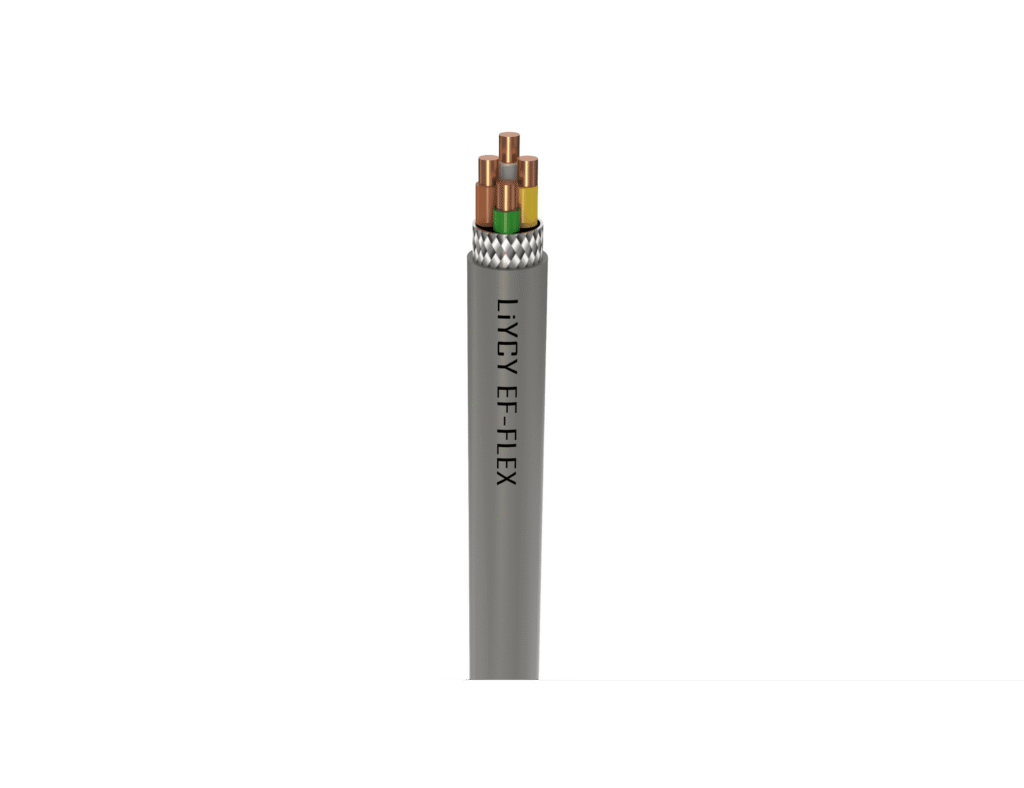
A screened cable incorporates an additional conductive layer around some or all of its conductors. Depending on the cable construction, this may include:
- Copper braid
- Aluminium foil
- A combination of foil and braid
- A drain wire used in conjunction with a foil screen
The purpose of this screen is to reduce the coupling of unwanted electromagnetic energy into or out of the cable.
This becomes particularly important when low-level signals, instrumentation, control circuits or data communications operate close to electrically noisy equipment.
However, screening does not change the fundamental rule of cable selection: the cable must first be electrically and mechanically suitable for the application.
A screen will not compensate for:
- An undersized conductor
- An unsuitable voltage rating
- Incorrect insulation
- Excessive cable capacitance
- Incorrect communication impedance
- Poor termination
- Unsuitable mechanical construction
For that reason, replacing an unscreened cable should always be treated as a cable specification exercise rather than simply an EMI upgrade.
6 Checks to Make Before Replacing an Unscreened Cable
The safest way to evaluate the replacement is to work through the cable specification systematically.
1. Confirm the Electrical Specification First
Before considering the screen, verify that the proposed replacement meets the circuit’s fundamental electrical requirements.
| Specification | What Should Be Checked? |
| Number of cores | Does the cable provide the required conductors? |
| Conductor size | Is the cross-sectional area suitable for the circuit? |
| Voltage rating | Is the cable rated appropriately for the operating voltage? |
| Current requirement | Can the conductors carry the required load? |
| Temperature rating | Is the cable suitable for the expected operating temperature? |
| Insulation | Is the insulation material appropriate for the installation? |
| Conductor construction | Is it suitable for fixed, flexible or continuous movement? |
One of the most common specification mistakes is assuming that two cables are interchangeable simply because they contain the same number of cores.
For example, a four-core screened cable is not necessarily an appropriate replacement for a four-core unscreened cable. Conductor size, voltage rating, insulation and application all still need to match.
The screen should be considered after these fundamentals have been confirmed.
2. Check the Signal Characteristics
This becomes especially important when the cable carries data, instrumentation or low-level signals.
Depending on the application, the following characteristics may be critical:
- Characteristic impedance
- Capacitance
- Pair construction
- Conductor arrangement
- Twisting
- Screening construction
- Maximum transmission distance
Two cables may look similar physically while behaving very differently electrically.
This is particularly relevant with industrial communication protocols, encoders, instrumentation and fieldbus systems.
Where a manufacturer specifies a particular cable type or electrical characteristic, that specification should take priority over a general screened cable selection.
The correct question is not simply:
“Does this cable have a screen?”
It is:
“Does this cable have the correct electrical construction for this particular signal?”
3. Determine How the Screen Will Be Terminated
This is one of the most important considerations when converting from unscreened to screened cable.
A screen cannot simply be added without considering how it will be connected at each end of the circuit.
Before installation, establish:
- A dedicated screen termination point on the equipment
- Connector compatibility with screen continuity
- The need for a suitable EMC gland
- The need for a screen clamp
- The equipment manufacturer’s recommended screen termination method
- Screen continuity along the full cable route
The effectiveness of a screened cable depends heavily on the quality of this termination.
A poorly terminated screen can significantly reduce the benefit of fitting screened cable in the first place.
Long, narrow connections between the screen and the termination point should also be avoided where EMC performance is important. A low-impedance, suitably designed screen connection is generally far more effective.
The key principle is straightforward:
A screened cable should not be specified without also specifying how its screen will be terminated.
4. Review Earthing and Bonding
Cable screening and protective earthing are related concepts, but they perform different functions and should not be treated as interchangeable.
Introducing screened cable adds another conductive element to the installation. The way this screen is connected needs to be considered as part of the wider EMC and bonding arrangement.
This may involve reviewing:
- Protective earth
- Functional earth
- Equipotential bonding
- Control panel bonding
- Equipment enclosures
- Potential differences between connected equipment
- Manufacturer-specific EMC instructions
It is also important to avoid applying blanket rules such as always connecting a screen at one end or always connecting it at both ends.
The correct arrangement depends on factors including:
- Frequency of interference
- Equipment design
- Signal type
- Installation layout
- Manufacturer recommendations
- Applicable EMC requirements
In professional cable selection, screen termination is therefore considered alongside the equipment design rather than treated as an isolated cable decision.
5. Check Whether the Screened Cable Will Physically Fit
Screened cables are often physically different from their unscreened equivalents.
The additional foil, braid, bedding or sheath construction can increase the cable’s overall diameter and may also affect its flexibility.
Before replacing the cable, check:
- Overall cable diameter
- Minimum bending radius
- Cable gland size
- Connector entry size
- Conduit capacity
- Cable tray space
- Space inside control cabinets
- Terminal accessibility
This can become particularly important during retrofit work.
An existing installation may have been designed around the outside diameter of the original unscreened cable. A larger screened version may require new glands, connectors or cable management components.
The electrical replacement may therefore be suitable while the physical installation is not.
6. Consider the Mechanical and Environmental Conditions
The screen should never become the only specification criterion.
The cable still needs to survive the conditions in which it will operate.
Depending on the application, this may include exposure to:
- Oil
- Water or moisture
- Chemicals
- UV radiation
- Abrasion
- Heat
- Low temperatures
- Repeated flexing
- Continuous movement
- Mechanical stress
Consider, for example, an unscreened cable installed on moving machinery.
Replacing it with a screened cable designed purely for fixed installation may solve one EMI concern while introducing a mechanical reliability problem.
This is why cable specialists normally consider three areas together:
Electrical requirements + mechanical requirements + environmental requirements
Screening comes within that wider specification.
When Does Replacing an Unscreened Cable with a Screened Cable Make Sense?
There are several situations where moving to screened cable may be justified.
Industrial Automation Upgrades
New drives, motors or switching equipment may introduce additional electromagnetic noise around existing control wiring.
Sensitive Instrumentation
Low-level measurement signals may require additional protection from external electrical interference.
Equipment Replacement
A new controller, drive, or machine may specify screened cabling as part of the manufacturer’s EMC installation requirements.
Cable Rerouting
A signal cable that previously ran through a relatively quiet area may now need to pass closer to power cables or electrically noisy equipment.
Industrial Communications
Some communication systems require a specific screened cable construction to maintain reliable data transmission.
In each case, the decision is based on the requirements of the system, not simply on screened cable being perceived as the higher-specification option.
When Is a Screened Cable Not a Direct Replacement?
A screened cable should not be treated as a drop-in replacement if:
- The conductor size differs from the original requirement
- The cable’s voltage rating is unsuitable
- Signal impedance does not match the equipment requirements
- Existing connectors cannot accommodate the screened construction
- There is no appropriate way to terminate the screen
- The overall diameter exceeds the capacity of existing glands or conduits
- The cable does not meet the mechanical requirements of the application
- The operating environment requires different sheath or insulation properties
- The equipment manufacturer specifies a particular cable type
- The original fault has not been confirmed as an EMI-related issue
The important point is that “screened” describes one characteristic of a cable, not its complete performance specification.
Screened Cable vs Unscreened Cable Replacement Checklist
Before approving the change, use the following checklist:
| Area | Question to Ask |
| Conductors | Are the core count and conductor size correct? |
| Voltage | Is the cable rated for the operating voltage? |
| Current | Can the conductor safely carry the required load? |
| Signal | Are impedance, capacitance and other signal characteristics suitable? |
| Screen | Is the screening construction appropriate for the interference environment? |
| Termination | Can the screen be terminated correctly at the equipment? |
| Earthing | Does the arrangement follow the system’s EMC and bonding requirements? |
| Connectors | Can the glands and connectors accommodate the cable? |
| Routing | Is there sufficient space and bending radius? |
| Environment | Can the cable withstand the operating conditions? |
| Mechanical duty | Is it suitable for fixed, flexible or continuous movement? |
| Compliance | Does it meet equipment and project specifications? |
So, Can You Replace an Unscreened Cable with a Screened Cable?
Yes, in many applications you can.
But a technically correct replacement is not simply:
Unscreened cable → same number of cores → screened cable
A more appropriate selection process is:
Application → electrical specification → signal requirements → EMI risk → screen construction → termination and earthing → mechanical compatibility
Only when these factors have been reviewed should the screened cable be treated as a suitable replacement.
For industrial applications where electromagnetic interference, signal integrity or equipment requirements make screening necessary, Eco-Flex provides a range of screened cables for different control, signal and industrial applications.
Selecting the right cable from the outset helps ensure the screen performs as intended. If you need help choosing a suitable option, contact Eco-Flex to discuss your application requirements.
Frequently Asked Questions
Can I replace an unscreened cable with a screened cable?
Yes, provided the screened cable meets the same electrical, mechanical and environmental requirements. Its screen must also be terminated correctly for the application.
Is a screened cable always better than an unscreened cable?
No. Screened cables are useful where electromagnetic interference is a concern, but an unscreened cable may be perfectly suitable in electrically quiet environments.
What happens if a screened cable is not properly earthed?
Incorrect screen termination or earthing can reduce shielding effectiveness and may fail to resolve the original interference problem. Always follow the equipment manufacturer’s EMC and earthing requirements.
Does a screened cable need to have the same conductor size as the unscreened cable?
The replacement conductor size must meet the circuit’s electrical requirements. Screening does not compensate for an undersized conductor or an unsuitable voltage or current rating.
How do I choose between a screened cable vs an unscreened cable?
Consider the level of electromagnetic interference, signal sensitivity, cable routing, equipment specifications and operating environment. For existing installations, also check termination, gland and connector compatibility before making the switch.