
H07RN-F or PVC Cable? Choosing the Right Cable for Industrial Applications
Published Date: August 19, 2026
AI Summary
H07RN-F and PVC cables can both be suitable for industrial use, but they are designed for different operating conditions. H07RN-F is generally better suited to flexible, mechanically demanding, wet or exposed environments, while PVC cables can be a practical choice for protected, fixed installations where mechanical and environmental stresses are lower.
Key Takeaways
- H07RN-F is designed for demanding flexible applications. It is commonly considered where movement, moisture and mechanical stress are significant factors.
- PVC cable covers a much broader range of constructions. Suitability depends on the specific PVC cable rather than the material name alone.
- The operating environment should guide selection. Water, abrasion, oils, temperature and movement can be just as important as voltage rating.
- Higher specification is not always better. A suitable PVC cable may be more practical for protected fixed installations that do not require H07RN-F’s heavy-duty characteristics.
- Always compare the actual cable datasheets. Similar conductor sizes or voltage ratings do not mean two cables will perform equally in the same industrial environment.
Choosing between H07RN-F and PVC cable is not simply a question of which material is tougher.
For industrial installations, the more useful question is: what will the cable actually be expected to withstand?
A cable installed permanently inside a protected control panel faces very different conditions from one powering portable machinery, operating near water or being moved regularly around an industrial site.
When comparing H07RN-F vs PVC cable for industrial environments, factors such as movement, abrasion, moisture, oil exposure, temperature and installation method should therefore be considered alongside the basic electrical specification.
H07RN-F and PVC Are Not Directly Equivalent Cable Types
Before comparing them, it is important to understand that H07RN-F and PVC cable do not describe equivalent categories.
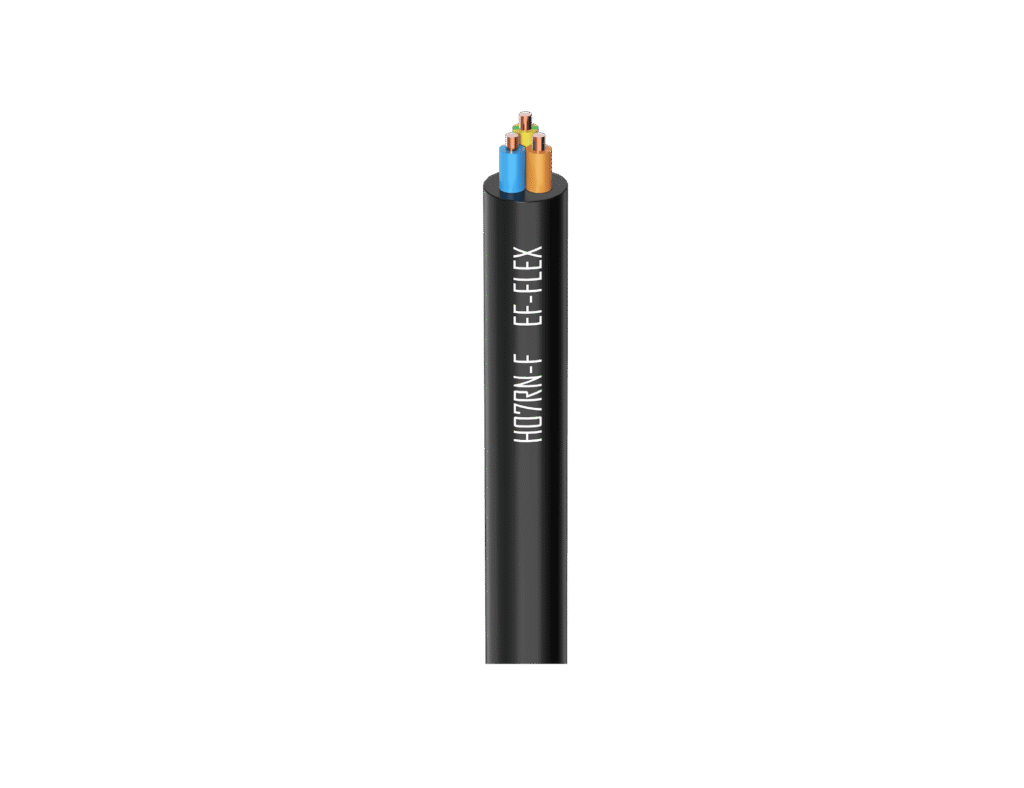
H07RN-F is a harmonised heavy-duty flexible cable designation. Broadly:
- H indicates a harmonised cable
- 07 refers to its 450/750 V voltage designation
- R identifies rubber insulation
- N identifies the outer sheath construction
- F indicates a flexible conductor
By contrast, PVC cable is a broad description covering many cables that use polyvinyl chloride as insulation, sheathing or both.
PVC cables can range from single-core fixed wiring to flexible multicore cables. Their mechanical and environmental capabilities vary considerably.
This means the real comparison is not simply rubber versus PVC.
It is between H07RN-F, which has a defined heavy-duty flexible construction, and the particular PVC cable being considered for the installation.
H07RN-F vs PVC Cable at a Glance
| Factor | H07RN-F | Typical PVC Cable |
| Construction | Flexible rubber-insulated and sheathed cable | PVC insulation and/or sheath |
| Flexibility | Designed for flexible duty | Depends on cable specification |
| Mechanical stress | Suited to more demanding environments | Varies considerably by type |
| Wet conditions | Commonly selected for demanding wet applications | Must be checked by product |
| Abrasion | Designed for robust industrial use | Depends on sheath construction |
| Oil exposure | Certain H07RN-F cables provide oil resistance | Depends on PVC formulation |
| Typical installation | Flexible, portable or exposed equipment | Often protected or fixed installations |
| Cost | Generally reflects heavier-duty construction | Often economical for standard duties |
This comparison should only be used as an initial guide. The individual product datasheet should always determine suitability.
1. Choose H07RN-F When Regular Movement Is Expected
Movement is one of the clearest reasons to consider H07RN-F.
Industrial cables may need to move because they are connected to:
- Portable machinery
- Pumps
- Mobile equipment
- Temporary power systems
- Equipment that is frequently repositioned
- Flexible industrial connections
H07RN-F uses flexible conductors and is designed for applications where the cable cannot simply remain stationary throughout its service life.
A PVC cable, meanwhile, may or may not be designed for movement.
Some PVC cables are flexible, while others are intended almost entirely for fixed installation. Choosing solely on the basis that both cables contain flexible copper conductors can therefore be misleading.
The correct question is:
What type and frequency of movement is the cable specifically rated to withstand?
For highly repetitive motion, even H07RN-F may not be the correct answer. A purpose-designed continuous-flex, drag-chain or travelling cable may be required instead.
2. Consider H07RN-F for Wet or Water-Exposed Industrial Areas
Water exposure can significantly narrow the list of suitable cables.
Applications may include:
- Drainage systems
- Water treatment facilities
- Pumps
- Outdoor industrial machinery
- Wet processing areas
- Temporary installations exposed to weather
H07RN-F is commonly selected for challenging wet environments because appropriately specified versions can provide strong resistance to water and demanding external conditions.
This does not mean that every H07RN-F cable should automatically be used underwater.
Immersion depth, duration, water type and operating temperature still need to be confirmed against the cable manufacturer’s data.
Likewise, PVC should not automatically be ruled out. Certain PVC cables can perform well in damp conditions.
The deciding factor is the specific environmental rating of the cable, not simply whether its sheath is rubber or PVC.
3. H07RN-F Is Better Suited to High Mechanical Stress
Industrial cables are not always neatly installed in protected enclosures.
They may be moved, dragged, handled, exposed to vibration or brought into contact with machinery and rough surfaces.
Typical mechanical risks include:
- Abrasion
- Repeated handling
- Impact
- Pulling
- Vibration
- Compression
- Contact with equipment surfaces
This is where H07RN-F’s heavy-duty construction can offer a practical advantage.
Its outer sheath is designed for more severe mechanical conditions than those expected of many standard PVC cables.
However, this does not mean the cable is immune to damage.
Incorrect installation, excessive pulling tension or continuous abrasion against sharp surfaces can still shorten cable life.
Where mechanical exposure is low, such as wiring inside a protected enclosure, specifying a heavy-duty rubber cable may provide little practical advantage over an appropriately rated PVC alternative.
4. Check Oil and Chemical Exposure
Industrial environments frequently contain substances that can attack cable sheath materials over time.
These may include:
- Hydraulic oils
- Lubricants
- Cutting fluids
- Cleaning chemicals
- Process chemicals
- Fuels
Certain H07RN-F constructions provide useful oil resistance, making them suitable for machinery and industrial environments where accidental contact with lubricants is expected.
But neither rubber nor PVC should be treated as a universal indicator of chemical resistance.
Before specifying either cable, establish:
- What substance will contact the cable?
- Will exposure be occasional or continuous?
- What concentration is involved?
- At what temperature will exposure occur?
- Does the manufacturer’s data confirm resistance?
A PVC cable formulated for one industrial environment may perform very differently from another PVC product.
Cable selection should therefore be based on the actual chemical exposure rather than the generic sheath material.
5. Compare Temperature Requirements Carefully
Temperature ratings can appear straightforward on a datasheet, but they need to be interpreted in context.
The relevant limits may differ according to whether the cable is:
- Fixed
- Moving
- Installed outdoors
- Carrying its maximum permissible current
- Exposed to cold starts
- Located near heat-generating machinery
For example, a cable may permit a lower minimum temperature when installed permanently than when it needs to remain flexible during movement.
This distinction matters.
A cable that survives a low temperature while stationary may not necessarily remain sufficiently flexible to be moved safely at that temperature.
When comparing H07RN-F and PVC cable, check both:
- Ambient operating temperature
- Permitted conductor temperature
Do not choose between them using a single headline temperature figure.
6. When PVC Cable May Be the Better Choice
Industrial does not automatically mean severe.
Many industrial cables operate in clean, protected and relatively stable environments.
A suitable PVC cable may be entirely appropriate where:
- The installation is fixed
- Mechanical stress is low or moderate
- The cable is protected inside a panel, conduit or machinery
- Significant oil exposure is not expected
- Water immersion is not required
- Ambient temperatures remain within its specified range
- The cable meets all electrical and regulatory requirements
PVC cables can therefore offer a practical and economical solution for many standard power and control connections.
This is an important specification principle:
The objective is not to select the toughest cable available. It is to select the cable that meets the actual duty without unnecessary over-specification.
Specifying H07RN-F for every industrial circuit can be unnecessary, just as installing an unsuitable standard PVC cable in a mechanically demanding environment can result in premature failure.
7. Voltage Rating Alone Should Never Decide the Cable
One of the easiest mistakes is comparing two cables based mainly on voltage rating and conductor size.
These characteristics are important, but they do not describe how the cable will perform mechanically or environmentally.
A proper industrial cable assessment should consider:
- Voltage
- Current-carrying capacity
- Conductor cross-sectional area
- Flexibility
- Movement frequency
- Mechanical stress
- Water exposure
- Oil and chemicals
- Temperature
- UV exposure
- Installation method
- Applicable equipment or project standards
Two cables can satisfy the same electrical load while being suited to completely different operating environments.
Which Cable Should You Choose?
The operating environment provides a useful starting point.
| Industrial Situation | Likely Starting Point |
| Fixed wiring in a protected environment | Suitable PVC cable |
| Portable industrial machinery | H07RN-F |
| Pumps and water-treatment equipment | H07RN-F where the product rating supports the conditions |
| Equipment requiring regular movement | H07RN-F or another movement-rated cable |
| High mechanical or abrasion exposure | H07RN-F where suitably specified |
| Standard indoor power connection | Suitable PVC cable |
| Machinery exposed to oils | Check H07RN-F or another oil-resistant cable |
| Severe outdoor conditions | Assess H07RN-F against the exact environmental requirements |
This table is a starting point, not a substitute for checking the cable datasheet and equipment requirements.
H07RN-F vs PVC Cable Selection Checklist
Before deciding, ask:
| Check | Question |
| Movement | Will the cable remain fixed or move during operation? |
| Mechanical duty | Will it experience dragging, abrasion or frequent handling? |
| Water | Is the location dry, wet or subject to immersion? |
| Oil | Will lubricants or industrial fluids contact the sheath? |
| Temperature | What are the actual operating temperatures? |
| Electrical load | Are voltage, current and conductor size suitable? |
| Installation | Is the cable protected, exposed, indoor or outdoor? |
| Standards | Does the equipment or project specify a cable type? |
Choosing Between H07RN-F and PVC Cable
There is no single best choice when comparing H07RN-F vs PVC cable for industrial environments. H07RN-F is generally better suited to movement, moisture, abrasion and demanding conditions, while PVC cable can be a practical option for fixed, protected installations.
The right choice should consider:
Electrical requirements → movement → mechanical stress → environment → cable construction → standards
Eco-Flex supplies both H07RN-F and PVC cables for different industrial applications. Contact Eco-Flex to discuss your operating conditions and find a cable suited to your requirements.
Frequently Asked Questions
Is H07RN-F better than PVC cable?
Not in every application. H07RN-F is particularly suited to flexible and demanding industrial environments, while an appropriately specified PVC cable may be preferable for protected fixed installations.
Can H07RN-F cable be used outdoors?
H07RN-F is commonly used in demanding outdoor and industrial applications, but the exact cable specification should be checked for temperature, UV, water and other environmental requirements.
Is H07RN-F suitable for continuous movement?
H07RN-F is flexible, but this does not automatically make it suitable for every continuous-motion application. Drag chains, travelling systems and highly repetitive movement may require a cable specifically designed for that duty.
Can PVC cable be used in industrial environments?
Yes. PVC cables are widely used in industrial installations, particularly where wiring is fixed and protected from severe mechanical or environmental exposure. The specific PVC cable must still meet the application’s electrical and environmental requirements.
What should I check before choosing between H07RN-F and PVC?
Consider movement, abrasion, water, oils, chemicals, temperature, voltage, current, installation method and any equipment or project specifications. The manufacturer’s datasheet should then be used to confirm that the selected cable meets those conditions.